
Understanding how industries are organized can be critical for businesses, investors, policymakers, and consumers alike. One of the most useful ways to organize and analyze the modern economic landscape is through business vertical classification categories. These categories provide a systematic framework for grouping companies and activities with similar economic functions or market focus. By classifying businesses into verticals, organizations can better understand competition, track trends, develop strategies, and communicate clearly with stakeholders.
In this detailed article, we will explore what business vertical classification categories are, why they matter, how they are structured, common models of classification, and practical applications. This guide is designed to help professionals, entrepreneurs, and curious readers gain a deeper understanding of how businesses fit into broader economic ecosystems.
What Are Business Vertical Classification Categories?
At its core, business vertical classification categories are a way of organizing businesses into logical groups based on shared characteristics. Instead of categorizing companies by size or geography, vertical classification focuses on what kinds of goods or services they provide, and who they provide them to.
For example, companies that sell automobiles, automotive parts, and car maintenance services can all fall under an “automotive” business vertical. Similarly, firms that deal with patient care, medical equipment, and pharmaceuticals can be grouped under “healthcare.”
In this context, a vertical is not merely a description of industry membership — it is a lens that helps analysts, managers, and strategists see patterns of revenue, customer needs, and competitive dynamics that cut across traditional sector boundaries.
Why Business Vertical Classification Categories Matter
Identifying and working with accurate business vertical classification categories is valuable for several reasons:
1. Strategic Focus and Specialization
Companies often use vertical classifications to better understand their competitive environment. A business considering expansion or new product development will examine its vertical’s trends, customer behaviors, and growth potential.
2. Competitive Benchmarking
By grouping companies into the same business vertical classification categories, analysts can compare performance metrics more meaningfully. Comparing a retail company to an oil producer would yield little insight — but comparing retailers with similar customer bases reveals performance drivers.
3. Market Analysis and Investment Decisions
Investors use vertical classifications to diversify portfolios or focus on sectors believed to have strong future growth. Identifying which business vertical classification categories are emerging or declining can help hedge risks and seize opportunities.
4. Tailored Marketing and Customer Targeting
Marketing teams often use vertical categories to refine messaging or product offers to specific audience segments. For example, SaaS providers might tailor content differently for financial services than for manufacturing — both are distinct verticals with unique pain points.
5. Policy Making and Economic Planning
Governments and international agencies rely on business vertical classification categories to monitor economic performance, track employment trends, and plan infrastructure or regulatory frameworks.
Core Business Vertical Classification Categories
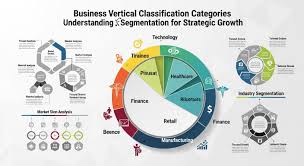
While classification systems vary in detail, business vertical classification categories most recognize several broad verticals that capture major areas of economic activity. Below are widely used categories.
1. Technology and Information Services
This vertical includes companies that provide hardware, software, IT services, and digital platforms. Subcategories might include:
- Software as a Service (SaaS)
- Cloud computing and data centers
- Cybersecurity
- Consumer electronics
2. Healthcare and Life Sciences
This vertical spans all activities related to medical care and human health, such as:
- Hospitals and clinics
- Pharmaceuticals
- Medical devices
- Biotechnology
3. Financial Services
Business vertical classification categories under this group address the financial management of money and risk:
- Banking
- Insurance
- Investment and asset management
- Fintech
4. Consumer Goods and Retail
This vertical encompasses businesses selling products and services directly to individual consumers, including:
- E‑commerce platforms
- Brick‑and‑mortar retail
- Fast‑moving consumer goods (FMCG)
5. Manufacturing and Industrial Goods
This includes companies that produce physical products for business and consumer use:
- Automotive manufacturing
- Aerospace and defense
- Heavy machinery
- Specialized components
6. Energy and Utilities
Companies in this vertical focus on production, distribution, and management of energy:
- Oil and gas
- Renewable energy
- Electricity and water utilities
7. Telecommunications and Media
This vertical involves communications infrastructure and content distribution:
- Mobile and broadband services
- Broadcasting and streaming
- Publishing and advertising
8. Real Estate and Construction
This vertical focuses on the built environment:
- Residential and commercial property development
- Construction materials and contracting
- Property management
9. Transportation and Logistics
This vertical covers the movement of goods and people:
- Shipping and freight
- Airlines and rail
- Warehousing and supply chain services
These categories are not exhaustive — emerging areas like sustainability services, digital education, and the space economy are increasingly recognized as verticals or sub‑verticals as well.
Popular Models of Vertical Classification
There are several frameworks used to define business vertical classification categories. Some are more granular, while others are broad and high‑level.
1. NAICS (North American Industry Classification System)
Used in government reporting, NAICS divides economic activity into detailed industry codes that can map into vertical clusters.
2. SIC (Standard Industrial Classification)
An older framework, still used in some regulatory contexts, categorizes businesses based on primary activities.
3. Custom Corporate Frameworks
Many large corporations and consultancies develop proprietary vertical classification categories tailored to their strategic or analytical needs.
4. Digital Platform Categorization
Tech platforms like search engines, social networks, and app stores use data‑driven categorization, often mapping businesses into verticals based on user interactions and context.
Each model serves different purposes — regulatory, economic, competitive, or strategic — but all contribute to a shared understanding of economic roles.
Cross‑Vertical Trends Transforming Industries
Today’s economy is increasingly interconnected, and many innovations blur boundaries between traditional business vertical classification categories. Some key cross‑vertical dynamics include:
1. Digital Transformation
Technology is reshaping every vertical — from healthcare AI diagnostics to fintech solutions in banking, digital capabilities are critical across categories.
2. Sustainability and ESG Focus
Environmental, social, and governance criteria are now expectations across consumer goods, energy, and finance, reshaping priorities across verticals.
3. Platform and Ecosystem Models
Businesses are expanding beyond single verticals through platform strategies — for example, tech companies offering fintech services or retail brands launching proprietary digital platforms.
4. Globalization and Supply Chain Integration
Global supply chain dynamics connect manufacturing, logistics, and retail verticals, demanding collaborative strategies.
Understanding these trends through the lens of business vertical classification categories provides clearer insights into how innovation and disruption spread across industries.
How Businesses Use Vertical Classification Strategically
For executives, understanding and applying business vertical classification categories means better decision‑making. Here are ways organizations leverage vertical frameworks:
1. Market Entry Strategy
By identifying gaps and competitive pressures in specific verticals, firms can choose markets with higher demand or less saturation.
2. Product Development
Products tailored to the specific needs of a vertical (e.g., healthcare software vs. retail point‑of‑sale systems) are more likely to succeed.
3. Competitive Intelligence
Monitoring rivals within the same vertical classification helps firms benchmark performance and anticipate moves.
4. Talent Acquisition
Different verticals require different expertise — knowing where a company sits helps attract the right talent
Challenges in Vertical Classification
Alongside the benefits, there are challenges in using business vertical classification categories effectively:
- Ambiguity in boundaries: Some businesses operate in overlapping verticals, making classification subjective.
- Rapid innovation: Emerging sectors may outpace traditional classification systems.
- Global variations: Classification standards differ by country, complicating international comparisons.
- Data consistency: Accurate classification requires high‑quality data, which is not available for all businesses.
Addressing these challenges requires ongoing refinement in analytical frameworks and collaboration between industry, government, and research institutions.
Conclusion
Business vertical classification categories are essential building blocks for understanding how the modern economy functions. They provide structure to the complex web of industries, enabling better strategic decisions, clearer market insights, and more effective communication across stakeholders.
While vertical classification systems continue to evolve alongside technological and economic shifts, they remain at the heart of business analysis, marketing strategy, investment planning, and policy formulation. Whether in traditional sectors like manufacturing and retail or emerging domains like digital platforms and green technology, understanding where a company sits — and why — is foundational.
In a data‑driven world, mastery of business vertical classification categories empowers leaders to see patterns that others may overlook and to seize competitive advantages that are rooted in a deep understanding of industry structure and trajectory.
FAQs: Business Vertical Classification Categories
1. What are business vertical classification categories?
They are systematic groupings of businesses based on the type of goods or services they provide and the markets they serve.
2. Why are vertical classifications important?
They help businesses benchmark performance, target marketing, guide investment decisions, and align strategic planning.
3. How do verticals differ from sectors?
Verticals emphasize specific markets or functional areas, while sectors can be broader economic groupings.
4. Can a company be in more than one vertical?
Yes — many modern firms span multiple verticals, especially in technology and services.
5. How are verticals used in market analysis?
They allow analysts to compare companies with similar characteristics and identify trends within specific market segments.
